Penny and Giles Data Systems Ltd
Penny and Giles Data Systems
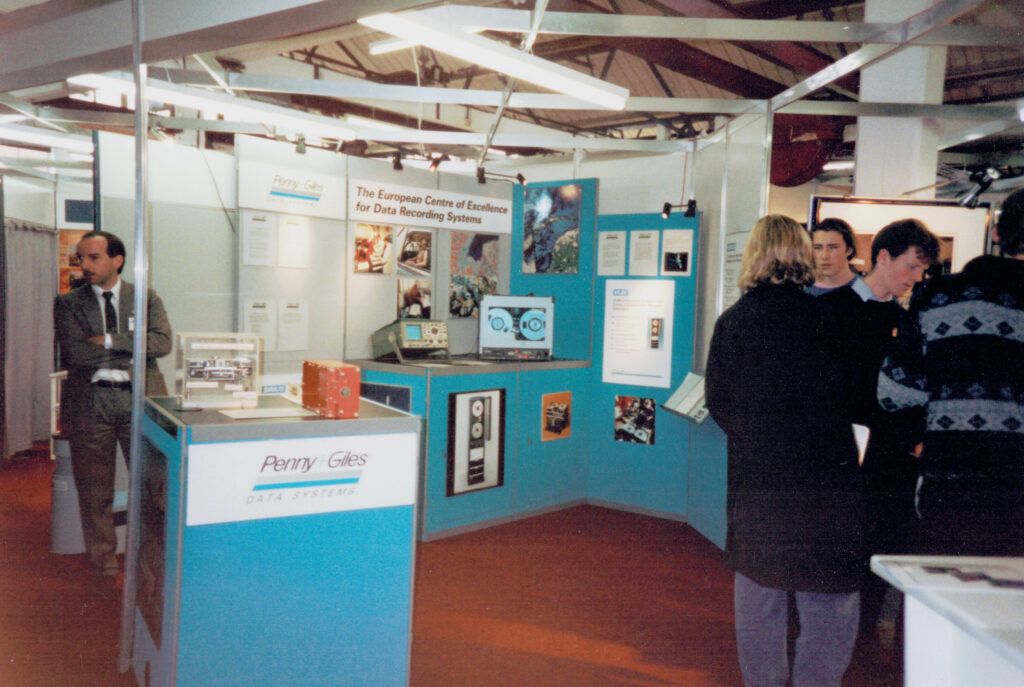
Penny and Giles Data Systems acquired Thorn EMI Datatech in 1987 as part of the Penny and Giles group of companies.
Penny and Giles was chiefly known for its range of transducers, and its very successful aviation flight data recorders. The company flourished until acquired by Bowthorpe Holdings, subsequently Spirent. The fit was poor, and the Penny and Giles companies were gradually wound down or disposed.
At this time, the European connection secured funding for development of a specialised system for the Joint Institute for VLBI in Europe headquartered in the Netherlands. Very Long Baseline Interferometry requires the processing of vast amounts of data from geographically spaced sources. At the time the only way of doing this was to record on magnetic tape at various Radio Astronomy sites around the globe, then send the tapes to a central processing facility for correlation. This requirement stretched the technology to the limit with very fine tracks ( up to 8000 across one inch tape) and servo controlled tracking. Here is a modified prototype 8000 track recorder.

People

Name the people in this picture? Picture includes Luigi , Mike, Alex, Mark, and Alan

Management
Managing Director : Colin Tarry
Managing Director at Disposal: Adrian Girling, Spirent PLC
SE7000 Portable Instrumentation Tape Recorder
SE7000 Instrumentation Tape recorder was the most successful product that SE Labs produced, lasting into the Penny and Giles era, although much reduced in volumes Over 700 of these units were produced from 1975 to 1990. The technology formed the basis of the larger SE9000 Laboratory Tape Recorder.

Penny and Giles Data Systems Brochure

Multiband Data Recorder
The multi-band data recorder was a cosmetic and electronic upgrade to the highly successful SE9000 recorder. It allowed for electronic setting of equalisers and FM parameters, previously a time-consuming job that required trained technicians to perform.
Multiband Data Recorder brochure and MDR Specification


Sirius Data Recorder
Sirius Data Recorder – containing the first brushless DC motor servo system was the successor to the MDR instrumentation tape recorder. By the time this model was introduced, the need for analogue recorders was starting to wane, and relatively few entered service.


SE9500 3PM Formatter

The transition from analogue to digital recording required the recognition of a large infrastructure of analogue tape recorders in the instrumentation recording world. Enterprises had invested large sums of money in analogue tape recorders ( regularly in excess of £100k per recorder) and needed to be able to maximise the investment while upgrading systems to handle digital input and output streaming.
The 3PM Formatter was designed to wrap around existing analogue tape recorders and convert digital data streams to a format suitable for the limitations of analogue-based high density digital tape recording.
Serial to parallel conversion of high rate digital data streams was the answer, with the parallel tracks being recorded on conventional IRIG multi-track tape recorders.
The 3PM formatter was one of the most successful products of the Thorn EMI Datatech/Penny and Giles era and found wide deployment worldwide, especially in satellite groundstations.
The paper “Digital Data Upgrade for IRIG Wideband Tape Recorders” explains this in more detail.
Pegasus Data Cassette Recorder
Pegasus Data Cassette Recorder introduced Microtrack ® recording for very high density data storage.
Despite innovative technology, the recorder was beset with design, production and management problems and was withdrawn. Shortly after the Company ceased trading in 1997 and the remnants were sold to Metrum Information Storage, a bleeding edge company specialising in the repair and servicing of legacy products. By this time, significant progress had been made using computer hard disk arrays to store digital data and these became much cheaper and naturally interfaced with the new generation of PC computers. By the year 2000, instrumentation tape recording had effectively ceased and had gone from a billion dollar worldwide industry to zero in just a few years with all the major players, ( Datatape, Honeywell, Racal, Thorn EMI, Schlumberger and Sony) exiting the business or ceasing to trade.